Generally Golden Retrievers are a robust healthy breed however they are predisposed to a number of health conditions. When purchasing a puppy it is essential that both parents have been health tested in accordance with the Royal Kennel Club and British Veterinary Association's guidelines and the results are favourable. A simple health check at the vets is not sufficient. The breeder should be able to show you the health certificates for both sire and dam. Assuming the sire and dam are KC registered, the results can be checked on the Royal Kennel Club's website by inputting the sire and dam's name here Health Test Results Finder | The Kennel Club
During COVID some breeders chose to have their x-rays sent to Australia and are continuing to do so. If this is the case, unfortunately the results will not be shown on the KC website.
A breeder may have also used the FCI in Europe to score hips and again these results will not be on the website. However, the breeder should be able to produce official documentation/scoring to evidence the hip test scores.
Despite best efforts to breed healthy puppies from health tested parents, there is no guarantee that the puppies will be free from hereditary diseases. What you are doing though, is reducing the risk and giving yourself the best possible chance of ending up with a healthy dog with a wonderful temperament that the breed is known for.
The following article, written for our 2023 Year Book by Anne Falconer, is helpful when trying to understand how we test for these conditions.
HEALTH TESTING AND THE GOLDEN RETRIEVER
Golden Retrievers should have health tests before being bred from, as well as being of sound temperament. There are tests that are carried out in different ways, radiographs, clinical examination and DNA testing.
RADIOGRAPHY
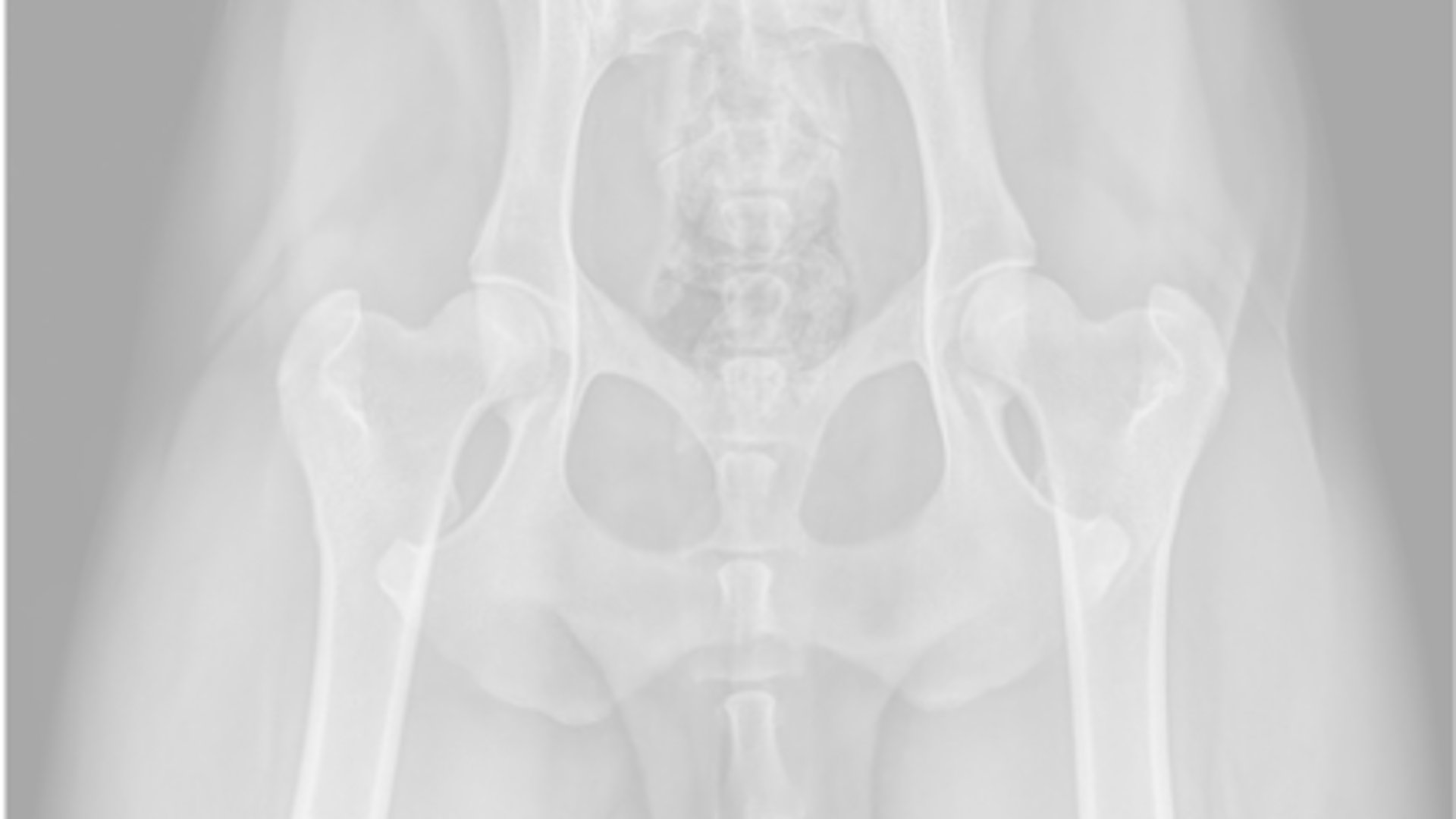
Hip Dysplasia Scheme
This is carried out under deep sedation or general anaesthetic and can be done at your own veterinary surgery or a centre that specialises in doing them. The radiographs then have to be sent away to be scored at the BVA or another body such as the Australian panel. The hips can be X-rayed once the dog is over 1 year of age.
The hips are scored individually with the best hips being 0/0 and the worse 53/53 total 106.
The median score for Goldens at present is 11 in total for both hips and BVA recommend breeding close to that score. Both parents should be scored, as well as all grandparents at the very minimum.
Elbow Dysplasia Scheme
The elbows can be X-rayed at the same time as the hips are X-rayed. They are X-rayed in two different positions. Again the radiographs are sent away to be scored and each elbow is scored individually, with the highest score being the eventual score, so a 2/0 elbow score will be 2 as will a 2/2 score.
BVA recommend only breeding from 0 scores.
Both these tests only need to be done once in the dog’s lifetime.
EYE TESTING
This is a test that has to be performed every year by clinical examination, with the exception of gonioscopy which is every three years. It has to be carried out by ophthalmic specialists who are approved by the BVA.
Hereditary Cataract
Often seen as posterior polar cataract which will not necessarily progress, but it can progress and this can cause dogs to go blind. No affected dog should be bred from.
Progressive Retinal Atrophy
Now rare in the country thanks to the diligence of breeders when it was first tested for and now there is a DNA test to totally eradicate it. It causes blindness.
Multifocal Retinal Dysplasia
First tested for back in the late 1980’s and due to inconsistent diagnosis was kept off the main schedule A, but was put back on recently. It is a condition that can ‘go’ as the dogs gets older and at present there is no evidence of any dog having gone blind, but obviously it will be monitored closely.
Gonioscopy
This test is to try and prevent Glaucoma developing and is a relatively new test. Investigation is going on to see if high PLA scores lead to Glaucoma. There are four grades 0 – 3.
0 and 1 are fine to breed from and 2 can be bred from provided they are mated to a 0 dog.
DNA TESTING
DNA is available for PRA 1 and 2 and Ichthyosis (ICT).
ICT is a skin condition where the skin sheds at a much faster rate than is normal and the dog has severe dandruff. In some cases, there is no shedding at all and in others a huge amount.
DNA tests give the result CLEAR, CARRIER OR AFFECTED.
Clear is as it says, no evidence of the dog carrying the problem. Carrier means it is carrying a copy of the gene, but will never be affected and Affected means it has the gene twice and symptoms may be seen.
Clear dogs are fine to breed from, as are Carriers and Affected, but they MUST be mated to a Clear dog so that the condition can be eliminated within a couple of generations and no Affected puppies will be produced.
No dog is perfect and despite all our efforts there will still be puppies born with inherited diseases but by testing we reduce the chances of that happening.
When buying a puppy please ensure that both parents have been tested for all the conditions listed above.
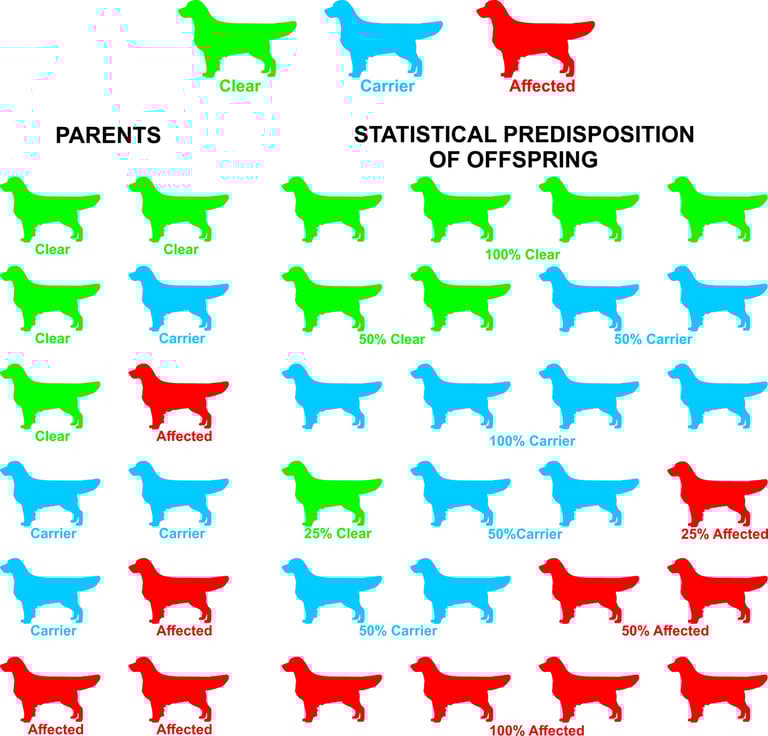
Inheritance Patterns
Author Anne Falconer (Siatham)
If you would like to learn more about health and health testing, please visit the following: